By Mark Whettall, Managing Director, CPV Ltd
 The UK Government’s Warm Homes Plan arrives at a moment when low-carbon heat is shifting from ambition to delivery. For heat networks, that matters: our sector has long sat between strong technical logic and uncertain commercial fundamentals. The Plan’s direction is clear – upgrade buildings, accelerate low-carbon heat and use policy levers that make investment easier to justify. For those of us focused on the buried realities of district heating, the message is both welcome and challenging: the next phase will reward schemes that can be delivered consistently, to higher standards, at scale.
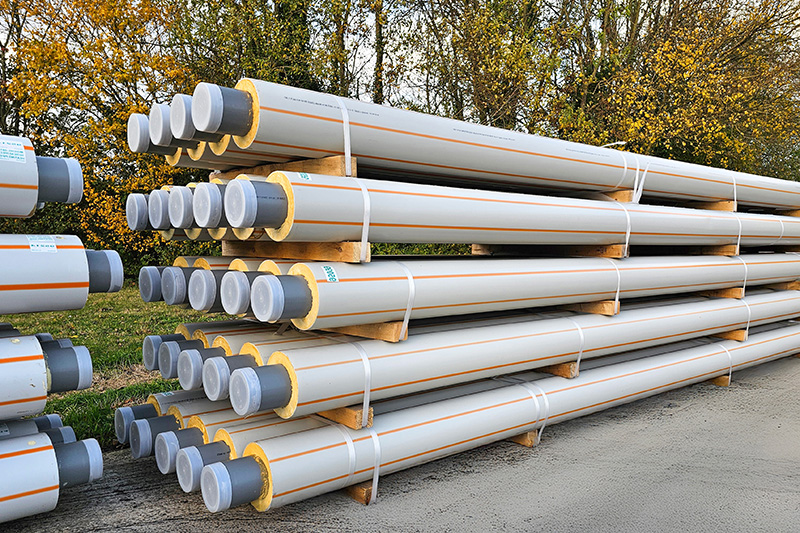
At CPV, we’ve entered our fifth decade of manufacturing pre-insulated pipe systems for buried heat networks right here in the UK, producing Hiline through booms, busts and policy resets. We’ve seen the shift from legacy, higher-temperature, higher-loss systems towards high-performance fourth generation networks – lower temperatures, better controls, diverse heat sources and a sharper focus on losses and lifetime cost. The Warm Homes Plan’s proposals for heat networks sit firmly in that world: city-scale networks, integrated with low-carbon sources, built for long-term performance.
A five-pillar push – and the right intent
What’s encouraging is the Plan’s multi-lever approach. For heat networks, that translates into: clear growth targets; place-based zoning to create investable demand; public funding to catalyse low-carbon schemes; stronger consumer regulation and higher technical assurance through new standards and compliance mechanisms. No single pillar fixes the sector’s underlying barriers, but together they can.
 7% by 2035 and 20% by 2050 – realistic, but only with delivery muscle
The headline ambition – doubling heat delivered by networks in England to around 7 per cent by 2035, on a trajectory to about 20 per cent of UK heat supply by 2050 – creates momentum and helps align the market. Government modelling is anchored in the National Zoning Model, identifying where networks are likely the lowest-cost route to decarbonising heat.
Is it realistic? It can be – but only if we’re honest about what needs to change. Investment must rise sharply and the UK needs more trained designers, installers, commissioning specialists and inspectors who understand district heating’s particular disciplines. If we don’t build that capability quickly, the sector will see familiar symptoms: programme delays, inconsistent quality and rising risk premiums.
It’s also worth saying that 20% should be seen as a starting point, not a ceiling. Once major trunks, networks and energy centres exist, infilling becomes progressively easier: redevelopment can be captured, new connections can be made opportunistically and whole districts can be converted building-by-building. Mature markets show that penetration can go well beyond early targets once the backbone is in place.
Zoning: demand certainty that changes the commercial maths – but the cadence matters
The Government’s response to the 2023 zoning consultation reinforces what zoning is meant to achieve: identify zones using a national model, refine them locally, consult, then designate – creating clearer expectations about where heat networks should be built and how they will be developed. It also points to an initial focus on at least ten of the biggest English towns and cities soon after zoning regulations go live, followed by further zones, with a published national ‘pipeline’ reviewed annually.
Directionally, that is right. But the phasing will be critical. If each tranche arrives too slowly, we risk a stop-start market: not enough volume to justify sustained investment in people, plant, and process across the supply chain. Demand certainty is valuable – but it needs to become visible demand on a timetable the market can gear up to.
On funding, the proposed support through the GHNF is welcome, but it won’t go very far against the scale implied by the targets. That said, the balancing factor is significant: if zoning works, it unlocks external investment by reducing volume risk. Public money becomes the catalyst, not the main event.
Manufacturing is ready – the constraint is people and process
From a buried infrastructure perspective, UK pre-insulated pipe manufacturing capacity is ready for growth. The bigger constraint is the wider delivery ecosystem: specialist installers, supervisors, quality assurance staff and client-side engineers with the experience to specify, inspect and accept networks built to modern standards.
That challenge sharpens further with the transition to stronger assurance and oversight. The Heat Network Technical Assurance Scheme (HNTAS) is expected to be phased in, with government indicating a planned launch in 2027. Meanwhile, Ofgem’s regulatory role brings heat networks closer to the consumer protection expectations of other utility markets. We welcome this – but we should be candid: a new level of engineering scrutiny will place further strain on an already under-resourced engineering sector.
Supply chain issues must be resolved before the Plan’s ‘accelerated deployment’ phase. That means mobilising training now. CPV is already providing training and support for installers, supervisors and inspectors because consistent quality cannot be retrofitted.
 De-skilling without devaluing: design for quality at speed
If deployment accelerates, simplifying how systems are installed becomes a strategic necessity. The solution isn’t ‘less quality’; it’s fewer opportunities for quality to slip. That is where innovation matters: making correct installation the easiest installation.
CPV is addressing this with new pre-insulated pipe systems that expand opportunities for hybrid networks – combining traditional steel where it makes sense with advanced polymers where performance, installation efficiency and corrosion resistance offer advantages. We’re also pushing approaches that reduce site variability. Hiline Clover, for example, is designed to simplify jointing through automated, computer-controlled welding – improving repeatability, speeding programmes and supporting robust inspection.
Don’t repeat the 1970s: standards must have teeth
When programmes accelerate and skills are tight, willingness to cut corners can creep in. That must not be allowed to happen. Ofgem, in its new role, will need to ensure that regulation – and future HNTAS enforcement – is sufficiently resourced and has real ‘teeth’ to uphold standards. The sector should avoid repeating mistakes made during the last boom we experienced in the 1970s, when inconsistent quality undermined confidence. With the new regulatory landscape, the signs are better – but only if enforcement is meaningful.
Competing with gas: be careful how we set the comparison baseline
Heat networks still compete with natural gas as the ‘default’ alternative – both in terms of perceived price and convenience. If heat network zoning is too tightly pegged to low-carbon targets too early, without parallel reform in energy pricing, it risks hampering network growth in borderline areas where networks are the right long-term answer but struggle on a short-term spreadsheet comparison.
A more gradual glidepath for carbon requirements, or earlier price rebalancing across electricity and gas, would level the playing field. Politically, that is a difficult step and in the current tumultuous climate in Westminster, it can look like a vote-loser. But if the Warm Homes Plan’s ambitions are to be met, the market signals need to support the outcome.
A call to action
The Warm Homes Plan moves heat networks closer to what they have always needed: investable demand certainty, clearer obligations, stronger consumer protection and higher technical standards. The practical question now is how we deliver the buried infrastructure that underpins performance and how we do it consistently at scale.
If you’re planning a scheme - from small domestic connections through to citywide transmission networks serving tens of thousands of consumers - CPV’s technical team would be pleased to discuss your options for buried pre-insulated heat networks and how best to optimise performance, resilience and whole-life value.
At CPV, we stand ready for the challenge and opportunities that the Warm Homes Plan will create.