By Mark Whettall, Managing Director, CPV Ltd
Heat networks now have a seat at the top table. You could view the commencement of Ofgem’s regulatory role in January 2026 as the defining moment, when heat networks came of age and could be seen as a vital part of national infrastructure. With zoning, regulation and consumer protection all accelerating, the conversation is shifting from whether to build heat networks, to how to build them – at pace, at scale and with performance that stands up over decades.
At CPV, we’ve been in this sector for more than forty years. As the longest-serving UK manufacturer of pre-insulated pipe systems for buried heat networks, we’ve spent that time producing Hiline pipes and supporting projects ranging from single-building connections right through to city-wide transmission mains serving tens of thousands of customers. We know from experience that the pipework is not a commodity. It’s the backbone that determines thermal losses, reliability, ease of maintenance and ultimately the lifecycle economics that make (or break) a scheme.
That is why a standards gap affecting modern rigid polymer pre-insulated pipe systems deserves urgent attention.
Why hybrid networks need a wider standards framework
Fourth generation heat networks demand lower heat losses, lower return temperatures, smarter monitoring and practical installation methods that cope with real-world site constraints and skills availability. Increasingly, that means a hybrid approach: combining different types of pre-insulated pipework within a single network, using each where it performs best.
Pre-insulated steel remains a proven option for higher temperatures, higher pressures and long transmission runs supplying large proportions of a network’s load. Polymer service pipes can bring advantages in corrosion resistance and installation simplicity. New generations of rigid polymer pre-insulated systems are pushing performance and constructability further still – helping to reduce Capex (through faster, more repeatable installation) and improve Opex (through lower losses, better network efficiency and long-term resilience).
But hybrid networks only thrive when designers, specifiers, installers and owners can rely on clear, consistent product and system standards.
What a bonded pre-insulated pipe system actually is …
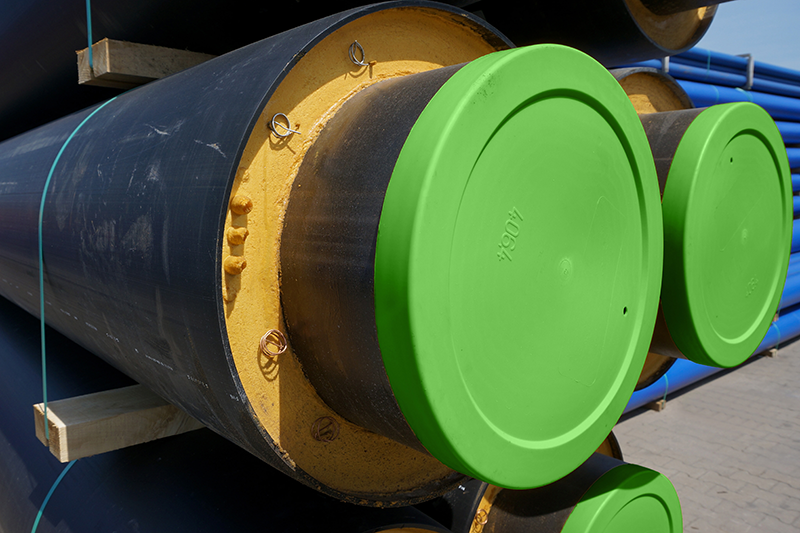 A modern bonded pre-insulated pipe for directly buried hot water networks is a pipe-in-pipe composite product, designed to act as a system rather than a set of independent components.
Using Hiline Steel as a familiar reference point (pictured right), a typical bonded system comprises of:
- Service pipe - steel pipe carrying the heat transfer medium
- Thermal insulation - polyurethane foam that bonds the service pipe and outer casing into one unit to control heat loss and manage shear forces
- Outer casing (commonly HDPE) providing mechanical protection and moisture barrier
- Jointing systems - for continuity of insulation and casing integrity across site welds and connections
- Surveillance / alarm elements - to detect moisture ingress early and reduce the risk of undetected failures
For rigid pre-insulated steel pipework, the UK has well-established BS EN standards that define requirements and test methods for these factory-made assemblies and their associated components – forming a common language for quality and compliance.
The EN standards landscape (as recognised in CP1)
CIBSE’s CP1 (2020) is recognised by government as the basis for minimum regulatory standards under the emerging Heat Network Technical Assurance Scheme (HNTAS).
Within the European standards family covering buried district heating pipe systems, the key BS EN references include:
BS EN 253 – factory-made bonded pipe assemblies (straight lengths) for directly buried hot water networks (steel service pipe / PUR insulation / PE casing)
BS EN 448 – factory-made fitting assemblies (steel / PUR / PE)
BS EN 488 – factory-made steel valve assemblies (steel / PUR / PE)
BS EN 489-1 – jointing systems for bonded single and twin pipe systems (hot water networks)
BS EN 13941-1 & -2 – design and installation for thermally insulated bonded single and twin pipe systems
BS EN 14419 – surveillance systems for bonded single and twin pipe systems
BS EN 15698-1 & -2 – bonded twin pipe systems (steel / PUR / single PE casing), including pipe assemblies and fittings/valves
EN 15632 (all parts) – pre-insulated flexible pipe systems (commonly associated with polymer service pipes supplied on a roll)
This framework has helped the industry specify, procure, build and assure bonded systems with consistency across projects.
The missing piece
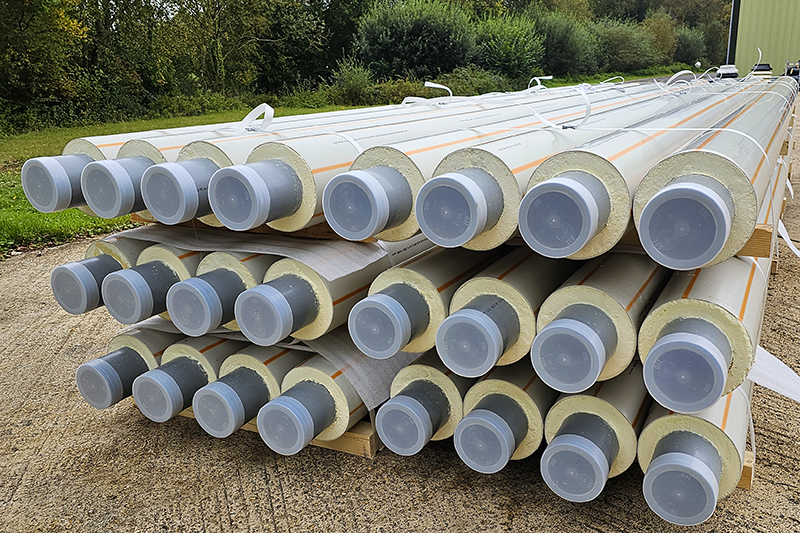 Here’s the problem: there is currently no equivalent ‘BS EN 253-style’ standard that covers rigid polymer pre-insulated bonded pipe systems as a complete assembly for buried heat networks.
Yes - there are standards covering the polymer service pipes themselves. In many rigid polymer heat network applications, that service pipe is typically polypropylene, sometimes with fibre reinforcement layers or composite construction to improve mechanical properties. Those material and pipe standards matter, but they don’t solve the core assurance question a heat network developer needs answered:
“How do we specify and verify the performance of the complete factory-made, bonded, pre-insulated pipe system – including insulation, casing, bonding behaviour, joint performance, and long-term system integrity – when the service pipe is rigid polymer rather than steel?”
Companies such as CPV recognise this issue and know that many of the performance principles and test methodologies defined in BS EN 253 remain directly applicable to modern rigid polymer pre-insulated pipe systems, meaning that these systems can meet the majority of the standard’s requirements to give confidence to heat network developers, even though the service pipe material differs.
However, without an assembly-level BS EN pathway, the sector risks fragmentation: project-by-project specifications, uneven test regimes, and inconsistent interpretations by designers, contractors, funders and insurers. That slows deployment and increases risk—precisely when the UK needs the opposite.
With our own rigid polymer pre-insulated systems, we know that they’re fit to out-perform EN 253 steel systems, but it’s essential that there’s a recognised standard to hang its hat on.
HNTAS is coming – so the standards map must be complete
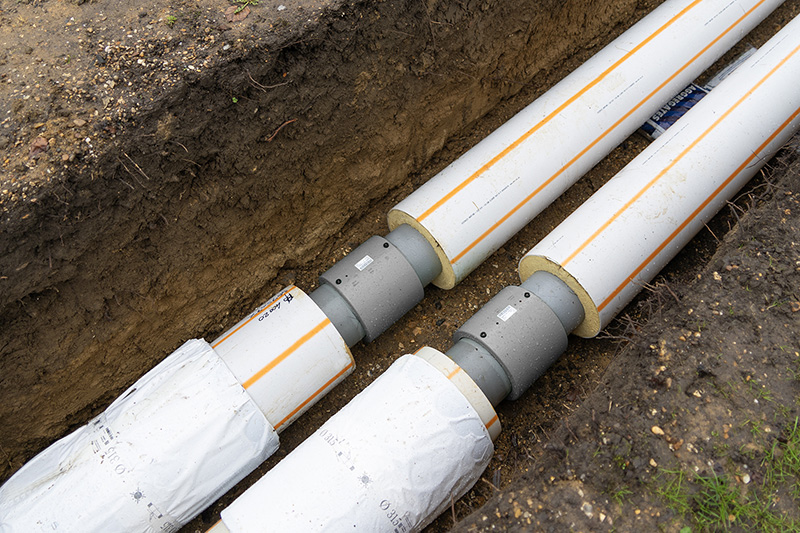 Government has been clear that CP1 (2020) underpins the direction of travel for mandatory technical requirements through HNTAS. The draft Heat Network Technical Standard (TS1) also signals the shift from code of practice to a more formal baseline standard.
This is exactly why we need to close any gaps now. Standards are not bureaucracy for its own sake – they are the mechanism that enables:
- fair, comparable procurement across supply chains
- repeatable quality assurance for installers and client teams
- clear compliance routes for regulated networks
- confidence for investors and adopters that performance claims are demonstrable
And importantly, we must ensure the framework supports innovations that can cut costs and tackle delivery constraints. Systems like the UK-manufactured Hiline Clover are designed to redefine what high performance can look like in a buried network – alongside easier, more de-skilled installation techniques that help protect programmes from skills shortages and site variability. If the UK is serious about targeted heat network growth, we cannot afford for modern rigid polymer bonded systems to sit in a standards grey zone.
A practical call to action
The industry has a choice: wait for standards to catch up organically, or work together—manufacturers, designers, trade bodies and regulators – to define an EN (and therefore BS EN) pathway that properly covers rigid polymer pre-insulated bonded pipe assemblies for buried heat networks.
In the meantime, developers should not feel forced into a one-size-fits-all approach. Well-designed heat networks increasingly benefit from mixing and matching pipe types to create hybrid networks that take the best of both worlds – optimising performance, constructability and whole-life cost.
If you’re planning a buried heat network – whether it’s a small domestic-scale connection or a citywide transmission spine – CPV’s technical team can help you evaluate options and optimise your design. Get in touch to discuss how to balance Capex, Opex, installation practicality and long-term performance and to ensure your network is ready for the standards environment now emerging under HNTAS.