Heating our homes, workplaces and public buildings still accounts for around a third of the UK’s greenhouse-gas emissions. Yet today, heat networks meet only about 3 per cent of our national heat demand, even though government expects them to deliver close to 20 per cent by 2050 to stay on track for net zero.
Within that challenge lies a huge – and still largely untapped – opportunity: the waste heat produced every day at energy-from-waste (EfW) plants across the country. The Environmental Services Association’s (ESA) new publication Energy from Waste Heat Networks – A Guide to Heat Offtake shines a welcome light on how we can finally make use of this resource, and its companion Heat Network Prospectus provides a plant-by-plant view of EfW heat potential via an interactive national map.
A mature fleet – but an immature heat market
 Modern EfW plants sit at the heart of the UK’s residual waste system, safely processing non-recyclable “black-bin” waste and generating electricity in the process. The heat produced is essentially a by-product of this sanitation service – heat that is currently being thrown away up the stack at most sites.
According to the ESA, the UK now has more than 60 operational EfW plants, with further sites under construction. Yet only around a dozen export significant quantities of heat to district heating networks or nearby industrial users. In 2024, EfW facilities delivered roughly 1,900–2,000 GWh of heat, while studies suggest the existing fleet could realistically supply around 20,000 GWh a year – a ten-fold increase.
Using the ESA’s own benchmark (around 12.5 MWh per dwelling per year), that unused capacity is equivalent to heating well over 1.5 million typical UK homes – without burning a single extra tonne of waste. That is an extraordinary level of under-utilisation for a low-carbon energy source that already exists in the right places, right now.
Proof it works: Sheffield and Nottingham
 This is not a theoretical opportunity. Cities like Sheffield and Nottingham have been using EfW heat to supply large-scale district heating networks for decades.
Sheffield’s district energy network, fed from the Sheffield Energy Recovery Facility, has been operating since the late 1980s and now supplies heat to thousands of homes and more than a hundred civic and commercial buildings through dozens of kilometres of pre-insulated buried pipework.
Nottingham’s long-running network, supplied from the Eastcroft EfW plant, provides low-carbon heat to one of the UK’s largest city-scale schemes.
These third-generation networks were pioneering at the time, designed around higher flow temperatures and traditional pre-insulated steel pipework. They prove the technical and commercial concept. The task now is to replicate – and improve upon – that success at scale, using modern fourth-generation heat network (4G) principles and technologies.
Perfect anchors for heat network zoning
EfW plants tick almost every box that policymakers are looking for as they roll out heat network zoning under the Energy Act 2023. When in place, heat network zoning will designate areas where heat networks are judged the lowest-cost low-carbon solution and then require certain building types – and crucially, key heat sources – to connect within defined timescales through secondary legislation (statutory instruments).
EfW facilities are:
- Long-lived, baseload assets with high availability, because they must continuously treat residual waste.
- Located close to heat demand, typically on the edge of towns and cities where waste is generated.
- Proven low-carbon sources, with the carbon burden attributed to the waste management function and EfW heat therefore treated as very low-carbon in the UK’s SAP methodology (around 0.015 kgCO₂e/kWh for networks with gas back-up).
For zoning to succeed, EfW needs to sit alongside industrial sites, data centres, mine-water schemes and other large heat sources as “must-connect” focal points for nearby zones – provided that connections are technically and economically viable. My hope is that forthcoming secondary legislation under the 2023 Act will be bold enough to make that expectation explicit.
Overcoming the barriers
Why hasn’t this happened already? The ESA guide rightly highlights a familiar set of barriers: the capital cost of connecting plant to network; uncertainty over long-term heat offtake; complex contractual arrangements (particularly where plants sit within PFI/PPP structures); and the loss of electricity revenue if steam is diverted to heat.
There is also a softer barrier: EfW’s public image. Too often, debates focus solely on emissions from stacks, rather than on the wider system benefit of replacing thousands of individual gas boilers with a single, tightly regulated plant plus a modern heat network.
The good news is that government policy is starting to address these issues. Zoning will provide much stronger demand certainty in designated areas, while ESA’s Heat Network Prospectus and its detailed plant-by-plant data make it far easier for heat network developers, local authorities and investors to identify viable projects and start meaningful conversations with EfW operators.
Building EfW-ready fourth-generation networks
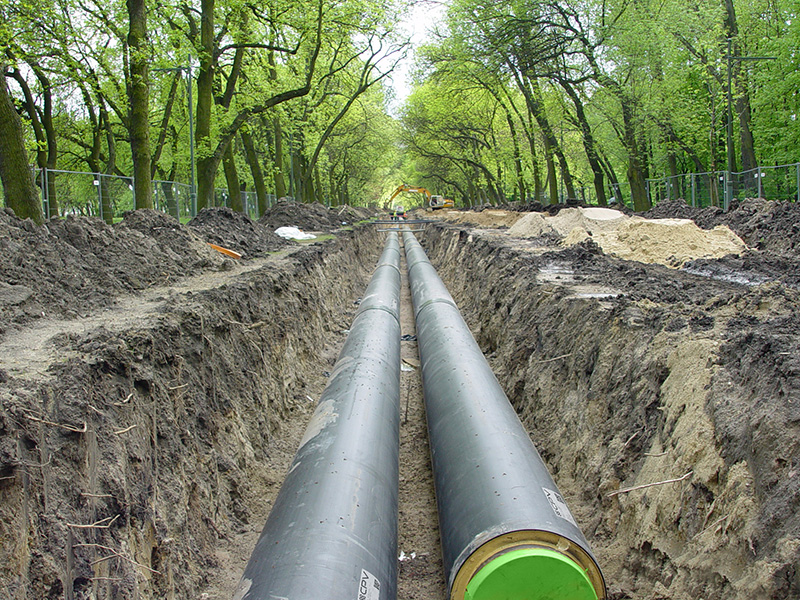 From a delivery perspective, the technology to connect EfW plants to 4G networks is mature and available today. Near the plant, where temperatures and pressures may remain relatively high, traditional pre-insulated steel pipe systems are still the workhorse solution – and CPV has been manufacturing such systems for buried heat networks for more than forty years through our Hiline range.
However, as networks move away from the plant and operate at the lower flow and return temperatures typical of fourth-generation designs, there is a compelling case for more advanced pipe technologies. Rigid pre-insulated polymer systems and advanced composites – such as our Hiline polymer solutions – can reduce installation costs, speed up construction and simplify connection into buildings, while still delivering excellent thermal performance and longevity.
In practice, the most efficient EfW-fed systems are likely to blend technologies: steel arterial mains for higher-grade heat close to the plant, transitioning to pre-insulated polymers and composites as temperatures are stepped down through heat exchangers or substations into city-wide low-temperature networks. The key is early, integrated design between EfW operators, network developers and experienced pipe system manufacturers.
From 3% to 20% – and beyond
If the UK is serious about growing heat networks from roughly 3 per cent of heat demand today to about 20 per cent by mid-century, we cannot afford to leave EfW heat on the table.
The ten-fold expansion in EfW heat output that ESA and the sector are targeting would go a long way towards that goal – and in my view, 20 per cent should be seen as a starting point rather than an end state for heat networks in a fully decarbonised energy system.
The ESA’s Energy from Waste Heat Networks – A Guide to Heat Offtake and its online Heat Network Prospectus (both accessible via https://esauk.org) are essential reading for anyone involved in planning, regulating or investing in heat networks.
At CPV, we stand ready to partner with EfW operators, developers, local authorities and investors to turn these opportunities into pipe in the ground – and low-carbon heat into people’s homes. If you are developing a new heat network, or looking at how to connect an EfW plant into an existing scheme, our technical team would be delighted to discuss the most appropriate mix of pre-insulated steel, polymer and composite pipe systems to optimise performance, cost and carbon for your project.