You can design the perfect low-carbon heating system … and still miss your decarbonisation targets. Not because of the heat pump. Not because of the controls. Because of the pipework. It’s the part of the system that rarely gets the spotlight but it’s where efficiency can quietly unravel, and where funding bids can fail before the project even breaks ground.
The overlooked weak link in decarbonisation
Across the UK, thousands of public and private buildings are in the middle of decarbonisation schemes. Some are driven by legislation like the Heat and Buildings Strategy; others are fuelled by funding streams such as the Public Sector Decarbonisation Scheme (PSDS).
The design brief is usually the same: replace gas boilers with low-carbon heat sources like air or ground source heat pumps, operate at flow temperatures of 60–70°C, and cut carbon.
But here’s the catch: once you generate that low-carbon heat, you have to move it through the building. If your distribution pipework can’t hold onto the heat, those savings start slipping away fast.
 That’s why CIBSE CP1 (2020) is so important. It doesn’t just cover buried district mains, it also highlights the need to minimise heat loss in secondary and tertiary distribution too: the risers, laterals and branch pipework that run above ground and inside buildings. These are often underestimated, yet they can be some of the worst culprits for wasted energy, higher OpEx and even the overheating of communal spaces. And that affects more than efficiency, it directly impacts comfort levels for occupants.
To put numbers on it, CP1 sets clear expectations:
- Flow temperatures no higher than 70°C
- Heat loss in communal systems no greater than 100 W per dwelling (with 70 W as the gold standard)
Fall short of these benchmarks and your carefully modelled carbon numbers won’t survive real-world testing. In the worst cases, funding approval or handover certification can be at risk.
Why boiler-era materials don’t cut it anymore
Steel and copper have been the default for decades and for good reason in the past. They were specified for boiler-led systems running at 80/70°C or higher, where distribution losses mattered less and the materials’ mechanical strength was a natural fit.
But decarbonisation has changed the operating regime. Heat pumps and heat networks typically supply at 60–70°C, and every degree of loss in distribution now carries a bigger efficiency penalty. Under these conditions, traditional metals no longer offer the same advantages. In fact, they can actively undermine performance.
Steel in particular is heavy, rigid and slow to work with. It requires hot works, meaning permits, downtime and fire safety overheads. It’s dependent on perfectly applied insulation on site to meet specification — and even then, junctions and supports are frequent weak points. For retrofit projects, steel is often impractical to route through tight risers or over roofs.
These issues matter even more in low-temperature networks. Every degree lost in distribution has to be replaced by the heat pump, which means higher electricity use, higher costs, and higher carbon. Put simply: steel was right for boiler-era systems. It isn’t right for decarbonisation.
Polymer systems designed for decarbonisation
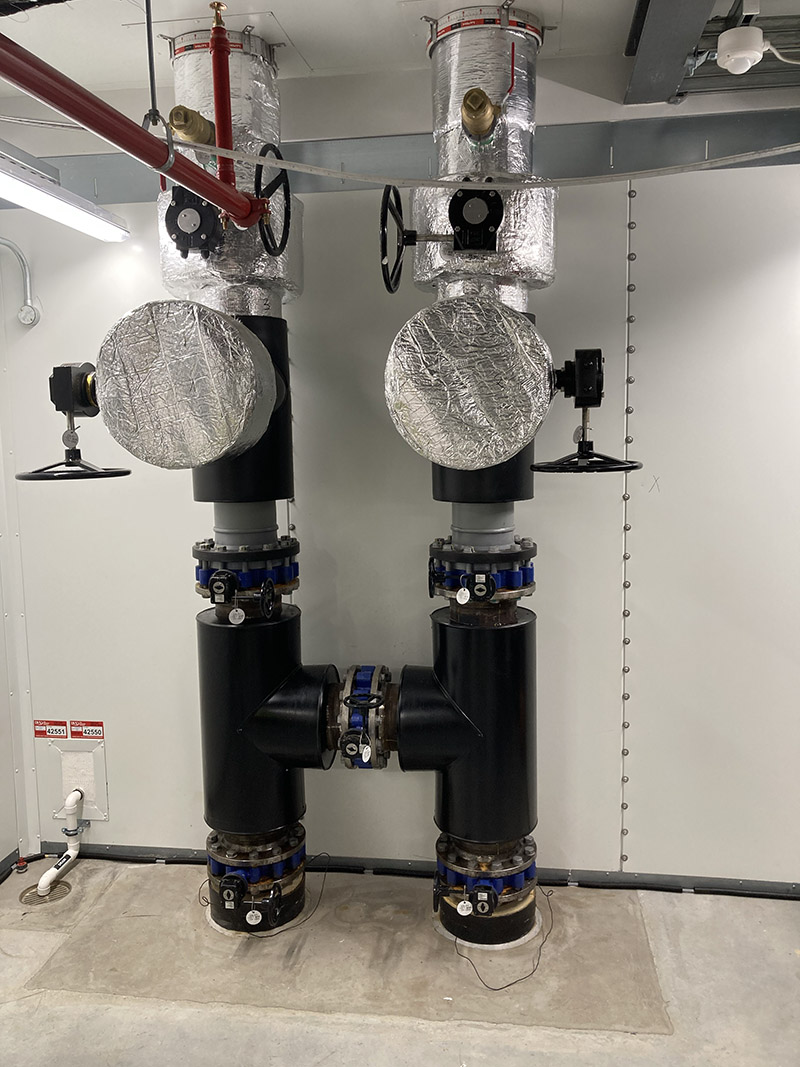 That’s why pre-insulated polymer pipe systems like CPV’s Hiline Clover are now being specified for above-ground building services.
They’re not simply “plastic pipes.” They are engineered solutions, built to European standards such as EN253, that integrate service pipe, rigid PUR insulation, and HDPE casing into a single bonded system.
And they bring efficiency benefits that metals cannot. Polymers have a smooth internal surface that reduces frictional resistance, allowing smaller pipe diameters and lower pumping energy. On large networks — where hydraulic efficiency and pump electricity consumption are critical — that translates directly into reduced operating costs and lower carbon.
Here’s what makes them a smarter choice for today’s decarbonisation projects:
1. Thermal performance aligned with CP1
Factory-applied bonded insulation delivers low heat losses along distribution runs, helping schemes stay inside CP1’s ≤100 W per dwelling requirement. For designers and operators, that translates into:
- Heat pumps achieving higher seasonal efficiencies (SCOP)
- Carbon savings that survive handover testing
- Compliance with the criteria behind funding approvals
For projects pushing for the highest standards, Clover can be specified with thicker insulation options (Series 2 or 3) to further reduce heat loss and lifetime operating costs.
2. Lightweight and flexible for retrofit reality
Most retrofit buildings don’t offer generous plant space or wide service routes. Clover’s lightweight polymer construction makes it practical to install where rigid steel simply won’t fit. No cranes, no oversized penetrations, and no elaborate access arrangements. Just pipework that threads cleanly through risers, along rooftops, and around obstacles.
3. Faster, safer installs without hot works
Clover uses electrofusion joints for both service pipe and casing. That means no flames, no sparks, and no hot works permits. A major advantage on live sites where safety and downtime are critical. Installation is quicker and more consistent, with reliable insulation continuity at every joint.
4. Corrosion-free operation but water quality still matters
Another long-term advantage of polymer systems is their corrosion-free operation compared to steel. But water quality management still matters. Operators need to maintain good chemistry across the whole system to protect any steel components, plant items, or legacy sections connected into the network.
5. Secondary containment and monitoring
The robust HDPE casing provides an inherent secondary containment layer. Fusion-welded joints prevent moisture ingress, preserving the insulation’s thermal performance over the system’s lifetime.
For critical networks, Clover can also be supplied with integrated leak detection wires within the PUR insulation. This allows continuous monitoring, early warning of leaks, and proactive maintenance reducing both risk and cost.
6. Built for exposure
Above-ground systems are often exposed to the elements. Clover’s UV-stabilised casing is designed for long-term outdoor performance, unlike repurposed buried systems. Whether it’s external risers or rooftop runs, the pipework maintains integrity, safety and appearance over decades.
The fire safety question
It’s important to address fire safety directly. Clover, like many pre-insulated systems, uses rigid PUR foam insulation. PUR has been scrutinised since Grenfell, but context matters.
- Clover is a controlled, specified building service product, tested and rated to relevant reaction-to-fire classifications.
- Internal runs can be detailed with fire collars, barriers, or compartmentation where required by design.
- External runs, separated from occupied areas, carry a far lower fire risk.
This isn’t unregulated façade cladding. It’s a tested component of a mechanical system, and when correctly designed, it satisfies the safety requirements of modern projects.
From specification to sign-off: why this matters
When distribution pipework performs, the whole scheme performs:
- Lower heat input is required to achieve comfort levels
- Heat pumps run more efficiently, using less electricity
- CP1 compliance is achievable, safeguarding carbon targets and funding cases
- Plant sizing and associated capex can be reduced
- Installation is faster and less risky, especially on occupied sites
Above-ground polymer pipework isn’t just an alternative to steel. It is a system-level enabler for low-carbon heating schemes that actually delivers in the real world.
Time to rethink the default
Despite all of this, many projects still default to steel. Often it’s habit, or supply chain convention, rather than technical suitability. But in the context of decarbonisation, taking into account efficiency benchmarks, funding deadlines, and reputational risks on the line, then uncritically sticking with steel can hold schemes back.
The question to ask on your next decarbonisation project isn’t simply “What pipe material do we usually use?”
It’s: “Will this choice help us hit CP1 targets, meet funding deadlines, and actually deliver the carbon savings we’ve promised?”
For more and more specifiers, designers, and contractors, the answer is clear. It’s time to pipe smarter, not harder.